News /14 October 2018
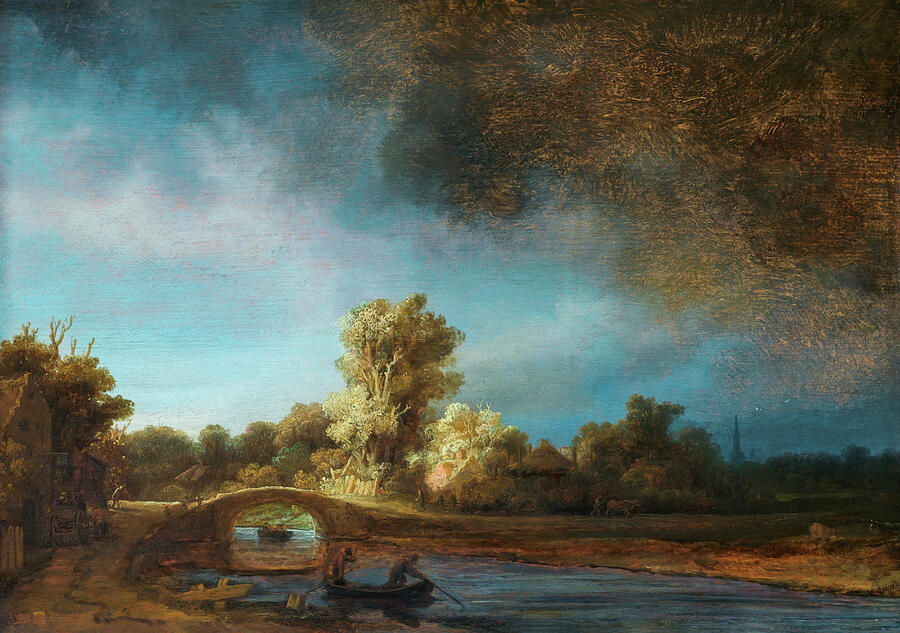
Rembrandt as a landscape painter
Rembrandt as a landscape painter — essay by E. Melanie Gifford, excerpt by Frits van Holten
Introduction
The 17th century was a time of artistic specialisation in painting, in which most painters devoted themselves to a particular genre — the landscape among them. Although his preference lay with history pieces and portraits, Rembrandt also painted landscapes from 1640 to 1650. Within the landscape genre there were also distinctions of style and subject, e.g.: Cornelis Poelenburgh – refined, idyllic Italianate landscapes; Jan van Goyen – monochrome scenes of the Dutch landscape; Jacob van Ruisdael – a landscape painter pur sang with heroic compositions.
But Rembrandt’s strongly emotional (dramatic) paintings cannot be placed in any of these categories. Seven of Rembrandt’s landscapes have survived, three of them dated. The following conclusions from research into the facture of his landscapes stem from technical examination of the seven paintings mentioned above and of six more by his closest associates, such as Govert Flinck and Ferdinand Bol. The research has confirmed the impression that Rembrandt’s landscapes differ fundamentally from those of his specialised contemporaries in: A) the technique with which the human figures were rendered. As a rule, figures were added only once the landscape had been worked out. With Rembrandt, the figures were worked on from the sketch onwards, at every stage of the painting process. B) the dramatic power of the lighting effects. It was also the rule that a sketch was made only in the dark foreground and that the sky was left light. Rembrandt first made a sketch of the whole, of the foreground as well as the sky, and through the addition of later layers of colour his paintings took on a dramatic rather than a naturalistic appearance.
Painting technique of the Dutch landscape around 1630
Until 1630 the leading style was that of the Italianate painters, which went back to the colourful fantasy landscapes and which had developed in Antwerp in the previous century. The space was divided into three zones to achieve a conventional atmospheric perspective: a) blue for the farthest distance b) green for the middle ground c) brown for the foreground. One began with a detailed underdrawing, fixed the various layers of depth with a coloured underpainting and then worked out the composition further.
The modern tonal style
From the 1630s the modern “tonal” landscape style became very popular. This style limited the underdrawing to a few brief indications or omitted it entirely. Instead of a bright underpainting, a large part of the composition was painted with a limited palette, directly on the support, wet-in-wet. By making use of the tint of the wooden panel and painting with only a limited number of pigments, a monochrome tonality was achieved for which these painters became famous.
Despite these great differences in style, there were generally accepted principles regarding a basic procedure. a) Genre and history painters first completed their figures and narrative elements and then worked out the surrounding space. Landscape painters, by contrast, worked from back to front. b) In the painting order, the layers closer to the viewer overlapped the more distant parts to enhance the sense of space. c) The sky was always painted lighter than the landscape, regardless of the weather conditions. Moreover, the sky was always painted directly on the ground, without dark underlayers.
Rembrandt’s working method in his landscapes, based on research into the painting “Landscape with the Good Samaritan”
Most landscape paintings by Rembrandt and his associates were painted on panel.
-
Ground. Both panels and canvases were given a double ground. A first layer of chalk and glue to smooth the surface. In the canvases this layer was reddish in colour. The second layer consisted of lead white and was tinted with clay brown and black to obtain a fine, neutral grey-brown colour.
-
First, so-called brown sketch, in one session. By beginning with a brown painted sketch, Rembrandt set up his compositions from the outset as a tonal unity and a pictorial rendering of light and shadow. The brown paint consisted of earth-coloured and black pigments. This layer functioned as a monochrome preliminary study. A few important details were indicated and the lit and shaded areas laid in with broad, sweeping strokes. The darkest passages were applied thickly, the lighter ones more thinly, and the lightest were left uncovered. In the sky, blue-grey tones were applied directly wet-in-wet. This layer had to dry before the next session could begin.
-
Second, so-called black sketch, in one session. In the black sketch Rembrandt gave almost all the elements their definitive place. His brushwork recalls his graphic work. The thickness of the brushstroke is used to indicate distance, suggesting receding perspective. In this black sketch Rembrandt also scratched with sharp objects to push the paint layer aside, so that it remained visible as fine lines in the overlying paint layers. In the black sketch, very limited colours were applied wet-in-wet for the foreground, e.g. the foliage and the trunks of the trees.
-
Final painting, wet-in-wet. For the top paint layer Rembrandt worked from back to front. First the sky, then the distance, the brightly lit plain in the middle ground, the shaded foreground and finally the glowing foliage at the bottom of the composition. In doing so he followed the contours of both his sketches. In the sky he leaves a great deal virtually unfinished, and the underlying sketches show through. The brightly lit central part was worked with light, very pasty paint. In the shaded part of the foreground the greater part of both sketches is again left uncovered. Where necessary, shadows are then added again with brown paint, and details are added once more with scratches.